How Is a PU Foam Midsole Encased in TPU Made? From Brooks DNA AMP to Modern Footwear Manufacturing
Quick answer: A PU foam midsole can be combined with a thin TPU skin so the foam provides cushioning while the TPU helps control deformation, reinforce the structure, and protect the surface. Commercial feasibility depends on TPU hardness and thickness, PU chemistry, interfacial adhesion, mold design, and a stable production window.
From Traditional Foam Midsoles to Multi-Material Systems
Traditionally, many running-shoe midsoles have relied primarily on a single foamed material, with EVA being one of the most widely used choices. EVA midsoles can be produced through compression or injection-molding processes, while PU foam has also been used where cushioning and long-term mechanical performance are required. Academic research has documented both EVA and PU as established running-shoe midsole materials.
In this conventional approach, much of the cushioning behavior is determined by the foam itself—its density, hardness, cell structure, geometry, and thickness. Designers can modify these variables or combine different foam densities, but the foam remains the primary structural and cushioning material.
A multi-material approach introduces another possibility: instead of asking one foam to provide every required property, different materials can be assigned different functions.
A soft foam core can provide cushioning and deformation, while another material can help control that deformation, reinforce the structure, protect the foam, or modify the way energy is returned. This gives footwear engineers another set of design variables beyond simply changing foam chemistry or density.

Brooks DNA AMP as a Case Study
Performance midsoles are no longer defined by a single material. Increasingly, footwear engineers combine different materials so that cushioning, rebound, stability, durability, and manufacturing requirements can be addressed within the same structure.
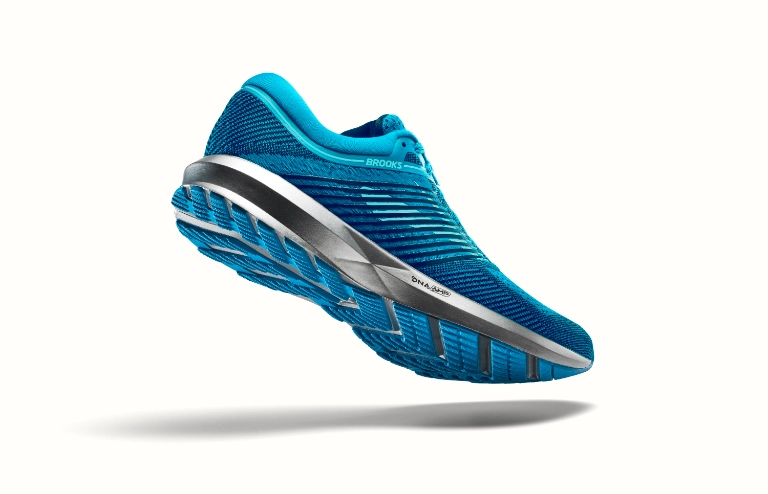
Brooks DNA AMP is a useful example of this approach. Brooks describes DNA AMP as polyurethane (PU) foam encased in a thin layer of thermoplastic polyurethane (TPU). Rather than allowing the foam to expand freely under load, the TPU skin helps control its deformation, contributing to the springy response associated with the cushioning system.
The concept is particularly relevant for material developers because it shows that TPU does not always need to be the primary cushioning foam. It can also serve as a functional layer that works together with another material.
The interesting engineering question, therefore, is not simply “Which foam should we use?” but:
How should the foam, TPU skin, component geometry, bonding, and manufacturing process work together?

How PU Foam and TPU Work Together
Brooks states that DNA AMP uses a PU foam combining plastic-like strength with rubber-like elasticity, surrounded by a thin TPU layer. The cushioning system is designed to absorb force during the runner's stride and return energy rather than allowing it to dissipate. The TPU casing is more rigid than the foam while retaining elasticity, helping restrict outward expansion of the foam.
There is also a direct material-development connection with BASF. In its official announcement for the original Brooks Levitate, BASF stated that the DNA AMP midsole was developed in partnership with Brooks using a new blend of Elastopan® Sports Light, with the polyurethane cushioning system tailored specifically for Brooks.

Creating Added Value Through Material Innovation
Premium running shoes using advanced midsole technologies were commonly positioned around US$150–180 at launch, including Brooks Levitate at about US$150, Saucony Freedom ISO at US$160, and adidas UltraBOOST at US$180.
This shows how material innovation can create added value beyond raw material cost. A well-developed PU foam + TPU skin system can help footwear brands differentiate through cushioning, rebound, support, durability, and design—supporting higher-value products rather than competing only on price.
| Running Shoe | Midsole Technology | Launch Price | Key Value | Source |
|---|---|---|---|---|
| Brooks Levitate | DNA AMP — PU Foam + TPU Skin | US$150 | Responsive rebound + structural support | BASF – Brooks Levitate / DNA AMP launch |
| adidas UltraBOOST | BOOST — Expanded TPU | US$180 | Cushioning + energy return | adidas UltraBOOST launch release |
| Saucony Freedom ISO | EVERUN — full-length TPU-based cushioning | US$160 | Lightweight + responsive cushioning | Footwear Insight – Freedom ISO launch reference |
| Nike Epic React Flyknit | Nike React Foam | US$150 | Lightweight + cushioning + energy return | Nike – Epic React technology launch / price confirmation (Sneaker News) |
These examples show that material innovation can create added value beyond raw material cost. Developing a PU foam + TPU skin system can help footwear brands differentiate through performance, structure, and design, supporting higher-value footwear products.
From an engineering perspective, this illustrates an important principle: the performance of a midsole cannot always be attributed to foam chemistry alone.
A foam core provides cushioning and deformation, while an external TPU layer can influence how that deformation occurs. Change the TPU hardness, thickness, geometry, or interface with the foam, and the behavior of the complete component may also change.
That is why a multi-material midsole should be evaluated as a system, not as two independent materials.
How Might This Structure Be Manufactured?
Brooks and BASF do not publicly disclose the complete commercial manufacturing process for DNA AMP, including the exact TPU grade, skin thickness, mold design, processing sequence, or production machine.
However, based on the publicly confirmed PU foam + TPU skin construction and conventional footwear manufacturing technologies, a reasonable engineering interpretation would be:
TPU skin or shell preparation → placement or formation in the mold → PU material metering and mixing → PU foaming/molding inside the TPU structure → curing and demolding → outsole bonding and final assembly.
The material system would therefore involve two different processing behaviors. The PU system must expand and cure to the required density, cushioning and rebound characteristics, while the TPU layer must provide sufficient flexibility and mechanical strength to control deformation without excessively restricting the foam.
The original PU chemistry is more clearly documented. BASF identifies the Levitate DNA AMP midsole as using a specially developed blend of Elastopan® Sports Light polyurethane. Brooks confirms that this PU foam is enclosed by a TPU skin, but the commercial grade and chemistry of that TPU have not been publicly disclosed.
Source: BASF polyurethane powers high energy return in new Brooks Levitate running shoes
The production equipment is even less certain. Public sources reviewed for this article do not identify the machine manufacturer used to produce DNA AMP, so it would not be appropriate to state that Brooks uses DESMA or any other specific machine.
From a manufacturing-engineering standpoint, however, such a structure would require equipment capable of accurately controlling PU metering and mixing, mold temperature, material placement, foaming or reaction conditions, curing, and the interface between the PU core and TPU skin. Depending on the actual production design, the TPU layer could also require a separate thermoforming, injection-molding, film-forming, or insert-preparation step before integration with the PU.
For manufacturers developing a similar PU foam + TPU skin concept, the important question is therefore not whether they can copy the DNA AMP process—which remains proprietary—but whether their existing molding equipment, mold design and TPU/PU materials can achieve the same type of functional architecture.
From Material Architecture to Manufacturing: Where DESMA Fits
Once a footwear concept moves from material development toward production, machine capability becomes part of the engineering equation.
This is where equipment suppliers such as DESMA become relevant—not because DNA AMP has been confirmed to use DESMA equipment, but because DESMA provides a real industrial example of how PU, TPU, molds, process control, and automation can come together in footwear manufacturing.
DESMA's direct-soling systems are designed to process PU, TPU, rubber, and other thermoplastic soling materials. Its PU systems incorporate precise dosing and mixing technology, while Multi Section Injection (MSI) allows different sections of a sole or midsole to be engineered with different properties, including varying hardness.
Source: Direct soling / DESMA Schuhmaschinen GmbH
Its unit-sole equipment also supports PU, TPU, rubber, other thermoplastics, and combinations of materials, demonstrating how material choice and production technology increasingly need to be considered together.
Source: Unit Soles / DESMA Schuhmaschinen GmbH
An Interesting PU + TPU Manufacturing Concept
Although there is no public evidence that Brooks DNA AMP is manufactured on DESMA equipment, an industry exchange between GOAFLEX and senior DESMA representatives raised an interesting potential manufacturing concept:
Use PU foam as the primary cushioning structure, while placing a TPU film or skin in the mold so that the two materials can be integrated during the molding and foaming process.
Conceptually, the two materials would perform different but complementary roles:
• TPU Film / Skin — Provides abrasion and scratch resistance, surface design possibilities, and structural reinforcement.
• PU Foam Core — Provides lightweight cushioning, deformation, and rebound.
This should be viewed as a potential development route rather than a confirmed Brooks or DESMA commercial process. The actual feasibility would depend on factors such as TPU film thickness and hardness, PU chemistry, mold design, processing temperature, material compatibility, interfacial adhesion, and production-cycle stability.
The concept is nevertheless technically relevant. DESMA publicly demonstrates PU/TPU material combinations in footwear manufacturing, and its equipment portfolio includes PU processing, TPU processing, multi-material production and in-mold integration technologies. For example, DESMA has described In-Mould Labelling using integrated plastic sheeting or textiles, while its boot-production technology also includes PU structures combined with manually placed TPU sole components.
Source: Latest news / DESMA Schuhmaschinen GmbH
DESMA has also continued developing footwear processing around TPU itself. Its SCF technology integrates supercritical-fluid foaming for thermoplastic soles such as TPU, illustrating how equipment technology and material development are increasingly connected.
Source: Latest news / DESMA Schuhmaschinen GmbH

What Is Known vs. What Is Not Publicly Confirmed
It is important to separate information disclosed by Brooks and BASF from manufacturing interpretation.
| Publicly Confirmed | Not Publicly Confirmed |
|---|---|
| DNA AMP uses PU foam encased in a thin TPU layer. | The exact commercial manufacturing sequence. |
| Brooks designed DNA AMP for cushioning and energy return. | The exact TPU formulation, hardness, and skin thickness. |
| BASF developed the PU cushioning material with Brooks. | PU foam density and detailed processing parameters. |
| The original Levitate DNA AMP midsole used BASF Elastopan® Sports Light technology. | Detailed mold construction and TPU–PU interface design. |
| TPU is part of the functional DNA AMP structure. | The specific production machine used for DNA AMP. |
| — | Whether Brooks or its manufacturing partners use DESMA equipment for DNA AMP. |
Brooks confirms the PU foam and TPU skin architecture, while BASF confirms its material-development partnership and Elastopan Sports Light technology.
Neither source identifies the commercial production equipment or provides the complete manufacturing sequence.
This distinction matters. DNA AMP is a useful case study in multi-material midsole engineering, but it should not be presented as evidence for a specific manufacturing method that has not been publicly disclosed.
What Manufacturers Should Validate Before Scale-Up
A PU foam + TPU skin concept may appear simple on paper, but successful commercialization depends on how multiple material and processing variables interact.
There is no single specification that defines the “correct” TPU hardness, foam density, skin thickness, or rebound for every performance midsole. Different shoe constructions require different targets. However, published footwear materials and established test methods provide useful reference points during development.
For example, commercial PU footwear systems illustrate how widely midsole properties can vary. Huntsman lists PU midsole systems with densities from approximately 300–450 kg/m³ and hardness around Shore A 40–45, while its DALTOPED® X-Lite system is published at 350 kg/m³, Shore A 50–55, 2.8 MPa tensile strength and 270% elongation.
Source: DALTOPED® Dual Density - Huntsman
BASF provides another useful reference. Its Elastopan® Light Midsole system is published at approximately 0.30 g/cm³ (300 kg/m³), Shore A 40, 3 MPa tensile strength and 280% elongation, with more than 90% tensile-strength retention after seven days of hydrolysis ageing at 70°C and 100% RH. These figures are useful benchmarks—not universal requirements for a PU + TPU construction.
Practical Validation Framework
Source: D2240 Standard Test Method for Rubber Property—Durometer Hardness
| Validation Item | Practical Development Reference | Why It Matters / Test Reference |
|---|---|---|
| TPU Hardness | Depending on the function of the skin, development may begin across a relatively broad Shore A range. GOAFLEX extrusion TPU alone covers approximately 60A–98A. | Hardness affects flexibility, restraint of foam deformation and structural support. ASTM D2240 provides a recognized durometer method for thermoplastic elastomers. |
| TPU Skin Thickness | No universal target. It should be optimized experimentally according to geometry, TPU hardness, weight and required restraint. | Even with the same TPU grade, changing film thickness can significantly change the stiffness and deformation of the finished structure. |
| Foam Density | Published footwear PU references include approximately 300–450 kg/m³ for conventional lightweight midsoles; performance systems can be designed outside this range. | Lower density reduces weight but can affect cushioning, dimensional stability and mechanical durability. |
| Skin–Foam Adhesion | Develop an internal minimum bond-strength target after establishing the actual TPU/PU construction. | Interface failure can cause delamination under flexing and compression. Peel strength can be evaluated using tensile-based methods; SATRA TM411 addresses bonds between footwear bottom layers. |
| Rebound / Cushioning | No single universal pass value. Compare prototypes under the same density, geometry and test method. | SATRA TM159 is specifically intended for cushioning materials and footwear midsoles and evaluates cushioning behavior under compression. |
| Compression Set | Lower permanent deformation is generally desirable; the acceptance limit should be defined by the shoe program. BASF has published a PU footwear concept with compression set <15% as one example. | SATRA TM64 evaluates percentage thickness change after a specimen is compressed and allowed to recover. |
| Fatigue Resistance | Test through repeated loading/flexing representative of the target footwear application. | SATRA provides footwear and sole flexing methods such as TM92 and related sole-fatigue methods to assess damage under repeated deformation. |
| Hydrolysis Resistance | Consider accelerated warm/humid ageing, particularly for PU and TPU systems intended for hot and humid markets. | SATRA TM344 typically exposes PU footwear materials to warm, humid ageing periods such as 7, 10, 14 days or multiples of seven days, followed by mechanical testing. |
| Dimensional Stability | Establish dimensional tolerances after molding, ageing and conditioning according to the component design. | Changes in foam expansion, TPU shrinkage and cooling can affect final geometry and fit. |
| Bonding Performance | Test the actual TPU/midsole/outsole/upper construction rather than resin specimens alone. | SATRA TM411 measures peel strength between sole/upper or bonded bottom-construction layers. |
| Processing Window | Establish repeatable ranges for temperature, pressure, shot/mix conditions, mold temperature, cure/cooling time and demolding. | The objective is not one optimum laboratory point, but a production window that tolerates normal manufacturing variation. |
Where GOAFLEX TPU Can Fit
The TPU skin should not be selected only by asking whether a material is “soft” or “hard.” Hardness, tensile strength, elongation, melt behavior and TPU chemistry all influence how the skin behaves during forming and how it interacts with the PU foam underneath.
GOAFLEX offers TPU materials with a wide range of physical properties. Across its published product families, hardness extends from approximately Shore 55A up to 71D, while its extrusion-grade FormMax portfolio covers approximately 60A to 98A.
Source: Goaflex Product — Goaflex
For a TPU film or skin development, several GOAFLEX extrusion grades illustrate how different property balances can be explored:
| GOAFLEX Grade | Chemistry | Hardness | Tensile Strength | Elongation | Why It May Be Worth Evaluating |
|---|---|---|---|---|---|
| FormMax-750 | Polyester TPU | 75A ±3 | 350 kgf/cm² | 550% | A relatively softer starting point where flexibility and deformation are important. |
| FormMax-809 | Polyester TPU | 80A ±3 | 250 kgf/cm² | 750% | Particularly high published elongation; potentially useful when the skin must accommodate significant deformation. |
| FormMax-858 | Polyester TPU | 87A ±3 | 295 kgf/cm² | 680% | Intermediate hardness with high elongation, giving a useful balance between flexibility and structural restraint. |
| FormMax-902 | Polyester TPU | 90A ±3 | 540 kgf/cm² | 490% | Higher tensile strength and hardness where greater structural support may be required. |
| FormMax-950 | Polyester TPU | 95A ±3 | 550 kgf/cm² | 430% | A substantially harder TPU option for structures requiring greater stiffness and restraint. |
These are GOAFLEX's published extrusion-grade properties.
GOAFLEX also offers polyether TPU alternatives. For example, FormMax-8708 is 87A ±3, 295 kgf/cm² tensile strength and 680% elongation, while FormMax-9008 is 90A ±3, 500 kgf/cm² tensile strength and 580% elongation.
For footwear exposed to moisture, sweat or humid environments, a polyether direction may therefore also be evaluated where improved hydrolysis resistance is important. The final choice still depends on the PU chemistry, bonding mechanism, forming method and required mechanical performance.
GOAFLEX's Role: Matching Material to the Shoe and Process
GOAFLEX can therefore provide more than one TPU hardness or a single fixed material solution.
Depending on the footwear design and manufacturing process, TPU properties such as hardness, tensile strength, elongation and processing behavior can be selected and further evaluated to match the required function of the TPU skin.
For example:
• Softer / higher-elongation TPU — → allows greater deformation and flexibility.
• Higher-hardness / higher-modulus TPU — → provides stronger structural restraint and dimensional support.
• Polyether TPU — → can be considered when hydrolysis and moisture resistance are priorities.
• Polyester TPU — → can be considered when mechanical strength and abrasion performance are particularly important.
The important point is that the TPU skin should be developed together with the PU foam density, mold geometry, skin thickness and production process, rather than selected independently.
These variables should not be optimized one by one. Increasing TPU hardness may improve structural support but may also change flexibility and the way the foam deforms. Reducing foam density may reduce weight but can influence cushioning, rebound, dimensional stability and durability.
The real target is therefore not the highest possible value for one property.
It is a balanced performance window that can be reproduced consistently in production.
From Material Selection to Production Validation
This system-level approach is also relevant to GOAFLEX's TPU development.
GOAFLEX's footwear portfolio covers injection molding, extrusion, hot-melt bonding, solvent-based adhesives, and supercritical-fluid foaming, allowing different TPU material directions to be evaluated according to the actual footwear component and manufacturing process.
The company's current material portfolio also includes polyester and polyether TPU grades for extrusion and injection molding across different hardness and mechanical-property ranges.
For a multi-material midsole, however, selecting a TPU grade is only a starting point.
A realistic development program should consider the complete production environment: the molding method, TPU geometry, target hardness, foam characteristics, bonding interface, mold design, and required finished-product performance.
Depending on the application, material development may also need to consider polyester versus polyether chemistry, hydrolysis resistance, non-yellowing requirements, flow behavior, or compatibility with subsequent bonding operations.
This is why GOAFLEX's footwear development approach begins with the part and production method before recommending a material direction, followed by practical validation before scale-up.
Beyond DNA AMP: Designing the Material System
The broader lesson from DNA AMP is not that footwear manufacturers should copy one specific Brooks construction.
It is that TPU can perform several different functions within a footwear system.
In one application, TPU may provide the cushioning through a foamed structure. In another, it may act as a skin, carrier, reinforcement, outsole, support component, bonding layer, or protective structure.
The development question therefore changes from:
“Which TPU grade should we use?”
to:
“What function should the TPU perform within this footwear structure, and what properties and processing behavior are required to achieve it?”
That question connects material chemistry directly with footwear engineering and production.
Developing a PU + TPU footwear component?
Send GOAFLEX your molding process, target TPU hardness, component design, bonding requirements, and performance targets.
Our team can review the application and recommend a starting material direction or sample for production evaluation.
Source: Explore GOAFLEX Footwear TPU Solutions
Explore GOAFLEX Footwear TPU Solutions →
Intellectual property notice: Product names and trademarks belong to their respective owners. Reference images are credited to their stated sources for technical discussion. If any information or material in this article is believed to violate intellectual property rights, please contact GOAFLEX at hello@goaflex.com so we can review and address the matter.