
What Is TPU? Thermoplastic Polyurethane Properties, Uses & Selection Guide
Quick answer
TPU (thermoplastic polyurethane) is a flexible, durable thermoplastic elastomer used when manufacturers need rubber-like elasticity, abrasion resistance, and efficient melt processing in one material. TPU can be injection molded, extruded, formed into film, or engineered as a hot-melt adhesive resin for footwear, apparel, industrial parts, tubing, films, and bonding applications.
For buyers and product developers, the key question is not only “what is TPU?” but which TPU grade fits the application, processing method, and performance target. GOAFLEX develops TPU materials for injection molding, extrusion, film, and adhesive applications, with formulation support for hardness, melt behavior, bonding performance, flexibility, and durability.
In this guide
- What TPU is and why manufacturers use it
- TPU material properties and performance advantages
- TPU vs rubber, PVC, and general TPEs
- Processing methods and grade selection
- Footwear and industrial applications
- Buyer checklist and FAQ
What Is TPU?
TPU stands for thermoplastic polyurethane. It belongs to the thermoplastic elastomer family, meaning it can behave like flexible rubber while still being processed like plastic.
Unlike thermoset polyurethane, TPU can be reheated and softened. During manufacturing, TPU softens when heated, flows during processing, and solidifies again when cooled. This makes TPU suitable for scalable thermoplastic manufacturing.
Common TPU Processing Methods
- Injection molding
- Extrusion
- Film extrusion and calendering
- Hot-melt adhesive processing
- Lamination and bonding processes
Because TPU chemistry can be adjusted, different grades can be developed for soft-touch parts, abrasion-resistant components, high-flex products, clear films, adhesive webs, footwear components, and industrial applications.
TPU Material Properties: Why Manufacturers Use It
TPU is widely selected because it combines multiple useful properties in one polymer system. Exact performance depends on the formulation, but key properties usually include:
- Abrasion resistance: useful for outsoles, wheels, belts, protective parts, and components exposed to repeated friction.
- Flexibility and elastic recovery: suitable for products that bend, stretch, flex, or move repeatedly.
- Tear and tensile performance: important for films, footwear parts, hoses, tubes, and industrial components.
- Wide hardness range: TPU can be formulated from soft rubber-like grades to harder structural materials.
- Processability: TPU can run on conventional thermoplastic equipment when the grade is properly matched.
- Bonding compatibility: selected TPU grades can be engineered for hot-melt adhesive, textile lamination, and footwear bonding.
TPU vs Rubber vs PVC vs General TPEs
TPU is often compared with rubber, PVC, and other thermoplastic elastomers. The best choice depends on cost, processing method, required durability, application environment, and end-use testing.
Material Comparison Snapshot
- TPU: best when the part needs abrasion resistance, flex performance, premium feel, or thermoplastic processing. The tradeoff is that the grade must be matched carefully to hardness, flow, bonding, and testing requirements.
- Rubber: best when the application requires specific heat, compression, or vulcanized-rubber behavior. The tradeoff is that processing is less thermoplastic and may be less suitable for TPU-style film, extrusion, or adhesive workflows.
- PVC / general TPEs: useful for cost-sensitive flexible products. The tradeoff is that they may not reach TPU-level abrasion resistance, mechanical strength, premium feel, or bonding performance.
When TPU Is Usually a Better Fit
- The part needs abrasion resistance and repeated flex performance.
- The product needs rubber-like flexibility with thermoplastic processing.
- The manufacturer wants injection molding, extrusion, film, or hot-melt bonding compatibility.
- The application requires a premium feel, clear film, or strong bonding performance.
Practical selection advice: for industrial buyers, the decision should be based on end-use testing, processing stability, and the full set of performance requirements — not only hardness or price.
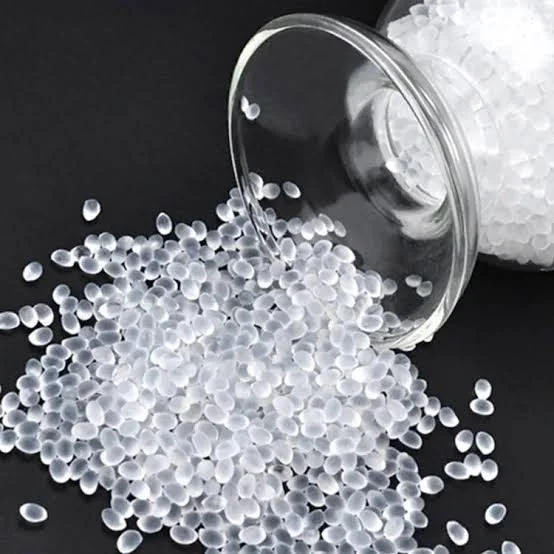
TPU Processing Methods and Grade Selection
Different TPU applications require different material designs. A grade that works well for injection molding may not be ideal for film, extrusion, or adhesive bonding. The processing method should be defined early when selecting a TPU material.
TPU for Injection Molding
Injection-molding TPU is used for durable flexible parts requiring consistent dimensions and stable processing.
- Footwear components and outsoles
- Protective parts and covers
- Sporting goods and consumer products
- Industrial components
- Wheels, rollers, and wear-resistant molded parts
Important selection factors: hardness, melt flow, demolding behavior, cycle time, abrasion resistance, tensile strength, tear strength, and color requirements.
TPU for Extrusion
Extrusion-grade TPU is designed for continuous production. Common applications include tubes, hoses, profiles, sheets, belts, and cable-related components.
Important selection factors include melt strength, extrusion stability, hardness, flexibility, surface finish, mechanical strength, and long-term durability.
TPU Film and Lamination Applications
TPU films are used when a product needs flexibility, durability, bonding performance, or protective properties in a thin material format.
Common applications include footwear, apparel, functional textiles, seamless bonding, protective films, and industrial laminations. Depending on the application, TPU films can be engineered for different thicknesses, activation temperatures, flexibility levels, and bonding requirements.
TPU Hot-Melt Adhesive Resins
TPU hot-melt adhesive materials are used for bonding applications that require flexibility, durability, and reliable adhesion. They are especially relevant in footwear, textile lamination, no-sew bonding, functional fabrics, and industrial bonding.
Key selection factors include substrate type, activation temperature, open time, bonding strength, wash resistance, flexibility, and production conditions.
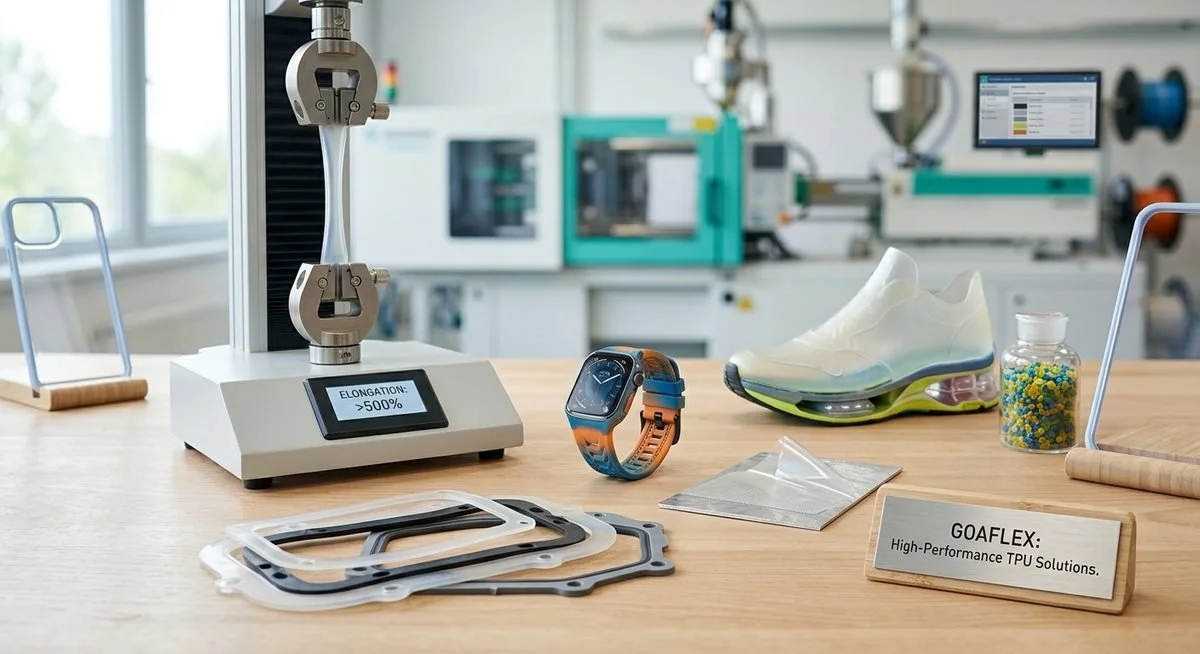

TPU Applications in Footwear
Footwear is one of the most important application areas for TPU. Modern footwear requires materials that can support performance, manufacturing efficiency, and design flexibility.
- Outsoles, midsoles, heel counters, toe components, and decorative parts
- Hot-melt adhesive films, no-sew bonding, upper reinforcement, and functional films
For footwear manufacturers, TPU selection should consider not only hardness, but also abrasion resistance, flex performance, bonding behavior, processing method, and final product requirements.
Related page: TPU footwear materials and applications.
TPU Applications in Industrial Products
TPU is not limited to footwear. Its combination of elasticity, mechanical strength, and abrasion resistance also makes it suitable for demanding industrial applications.
- Industrial hoses, pneumatic tubes, wheels and rollers, wear-resistant components, belts, protective components, cable applications, and sporting goods
For these applications, material selection should consider hardness, abrasion resistance, tensile strength, elongation, environmental resistance, and long-term durability.
How to Choose the Right TPU Grade
There is no universal TPU grade for every application. Before selecting a material, prepare answers to these questions:
- What is the final product or application?
- What processing method will be used: injection molding, extrusion, film, lamination, or hot-melt bonding?
- What hardness range is required?
- What mechanical properties matter most: abrasion, tensile strength, tear strength, elongation, or flexibility?
- What processing temperature and production conditions will be used?
- Does the material need to bond to fabric, leather, foam, rubber, plastic, or another substrate?
- Are there specific color, transparency, surface feel, or durability requirements?
- What testing conditions will be used to approve the material?
Clear answers help material suppliers recommend a TPU formulation that matches both the manufacturing process and the final product.
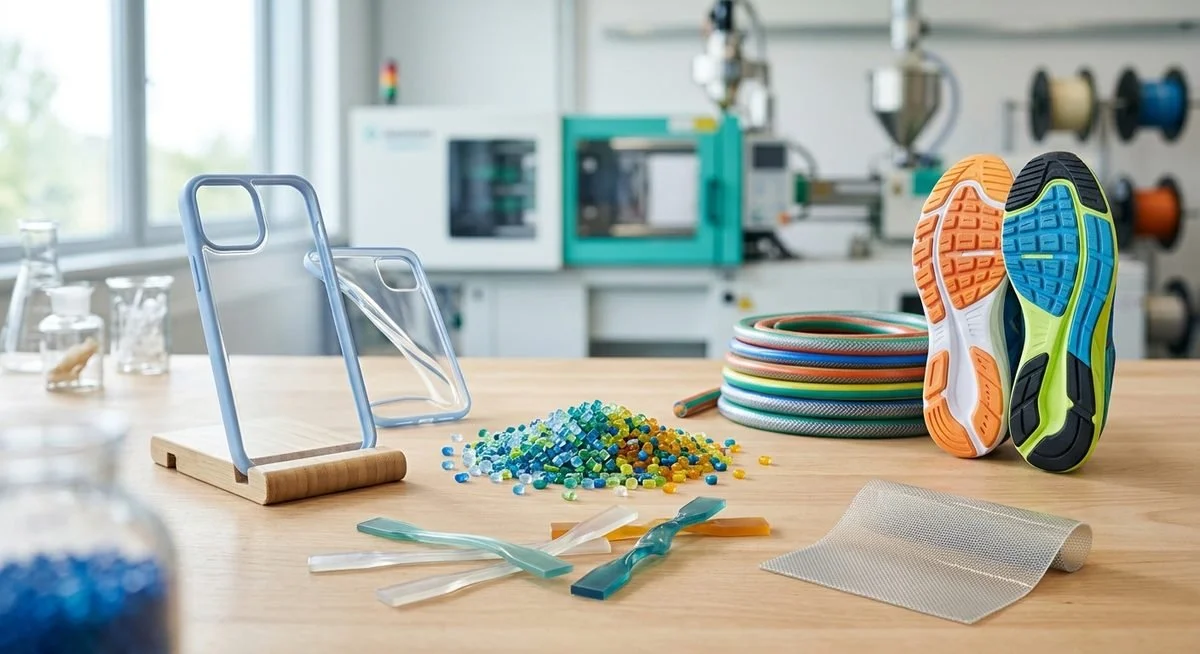
GOAFLEX TPU Material Solutions
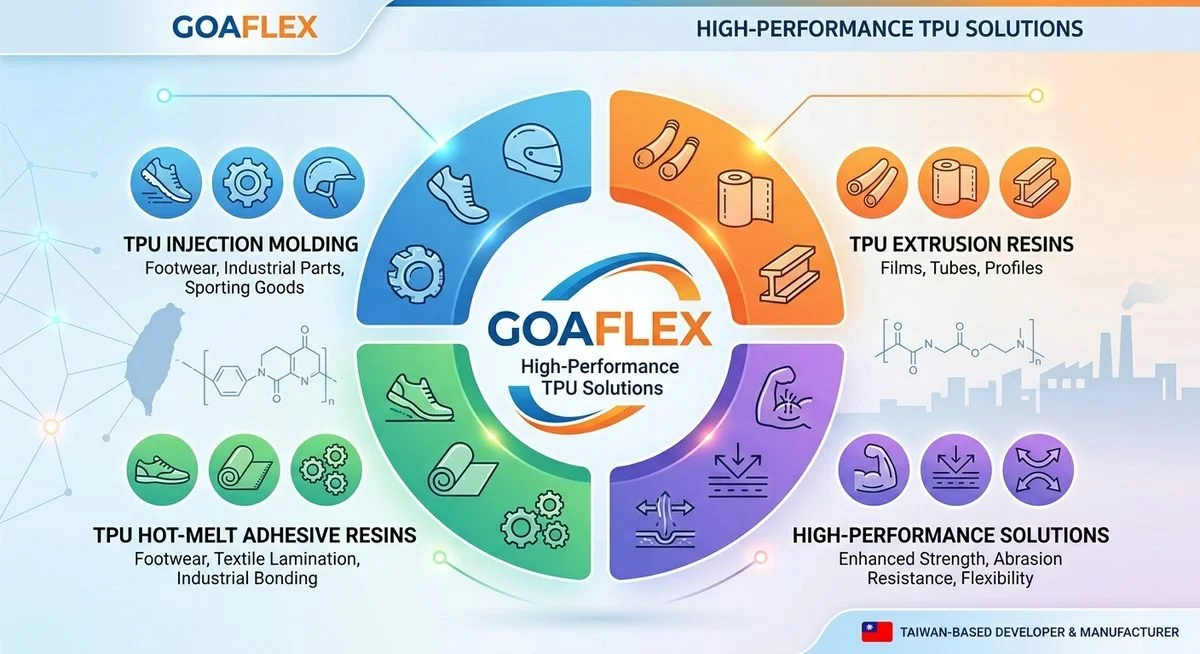
GOAFLEX is a Taiwan-based developer and manufacturer of advanced thermoplastic polyurethane materials. Our TPU solutions cover multiple processing technologies and application needs.
- TPU injection molding resins: for footwear, industrial parts, sporting goods, and molded applications.
- TPU extrusion resins: for films, tubes, profiles, and other extrusion applications.
- TPU hot-melt adhesive resins: for footwear, textile lamination, and industrial bonding.
- High-performance TPU solutions: for applications requiring mechanical strength, abrasion resistance, flexibility, bonding performance, or specialized processing behavior.
Rather than treating TPU as a commodity material, GOAFLEX focuses on matching material formulation, processing conditions, and application requirements.
Frequently Asked Questions About TPU
What is TPU used for?
TPU is used for footwear components, outsoles, films, hot-melt adhesives, hoses, tubes, belts, wheels, rollers, protective parts, sporting goods, apparel components, and industrial products that need flexibility, abrasion resistance, or durability.
Is TPU rubber or plastic?
TPU is a thermoplastic elastomer. It can behave like flexible rubber, but it is processed like a thermoplastic material. This means it can soften when heated and solidify when cooled.
Is TPU good for injection molding?
Yes. Injection-grade TPU is commonly used for molded parts that need flexibility, durability, abrasion resistance, and consistent dimensions. The correct grade must be selected for hardness, melt flow, demolding behavior, and end-use performance.
Can TPU be used as a hot-melt adhesive?
Yes. Certain TPU formulations are designed as hot-melt adhesive resins or films for footwear, apparel, textile lamination, no-sew bonding, and industrial bonding applications.
How do I choose a TPU supplier?
Choose a TPU supplier that understands your processing method, target hardness, substrate, bonding conditions, mechanical requirements, and final application. Material support and formulation matching are often more important than selecting a grade by hardness alone.
Need Help Selecting a TPU Material?
Choosing the right TPU is not only about hardness. Processing method, bonding conditions, mechanical requirements, substrate, and final application all influence performance.
If you are developing a new TPU application or looking for an alternative material for an existing product, talk to the GOAFLEX team. Tell us your application, processing method, target hardness, substrate, and performance requirements, and we can help evaluate the appropriate TPU solution.
GOAFLEX — High-performance TPU materials for better products and better manufacturing.
