
Polyether vs. Polyester TPU for Tubing and Hose: How to Choose
Quick answer: Polyether TPU is usually the better starting point for tubing exposed to water, humidity, microbes or low temperatures. Polyester TPU often deserves the first trial when dry-service mechanical strength and abrasion resistance dominate. That is a useful screening rule, but it is not a finished specification.
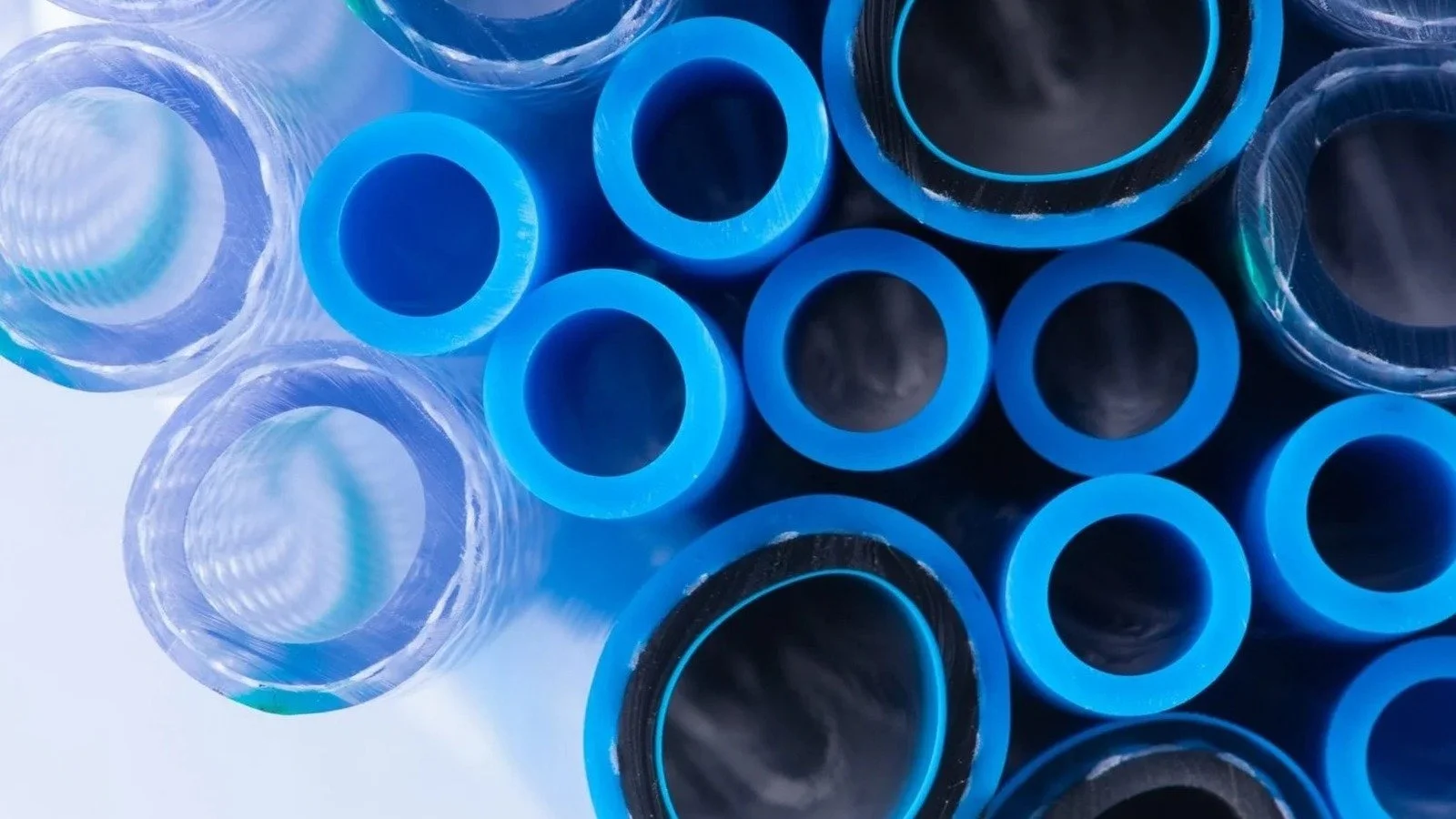
A tube's working pressure, bend radius, creep, chemical resistance and service life also depend on the exact formulation, hardness, wall geometry, processing history, fittings, temperature and exposure time. For outdoor use, the UV package and weathering data matter as much as the polyol chemistry.
This guide focuses on that practical decision: where polyether and polyester TPU differ, and what a tube or hose manufacturer should verify before approving a grade.
Start with the service conditions, not the hardness number
A Shore hardness target narrows the field, but two TPU grades at the same hardness can behave differently after months of humidity, repeated bending or contact with a process fluid. The base chemistry changes how the soft segment responds to water, cold, abrasion and biological exposure. Additives and the hard-segment design change the result again.
For a useful first conversation with a material supplier, define the service envelope before asking for a grade:
- What will flow through the tube: dry air, humid air, water, oil, fuel, coolant, cleaning solution or another fluid?
- What are the continuous and peak temperatures?
- Will the tube sit outdoors, under artificial UV, or behind a machine guard?
- Is it static, repeatedly flexed, dragged, coiled or routed through a cable carrier?
- What are the inside diameter, outside diameter and minimum bend radius?
- What working, proof and burst pressures are required?
- Which fittings and assembly method will be used?
- Are food-contact, drinking-water, medical, flame-retardant or other regulatory requirements involved?
These inputs do more than improve grade selection. They define the tests that should be run on the finished tube.
What changes between polyether and polyester TPU?
Polyether and polyester TPU share the same broad material family, but their soft-segment chemistry creates a different balance of properties.
Polyether TPU is commonly selected for better resistance to hydrolysis and microorganisms, along with good flexibility at low temperature. Those traits make it a practical candidate for washdown areas, humid factories, outdoor equipment, water contact and pneumatic lines where condensate may be present.
Polyester TPU is commonly selected for strong mechanical performance, wear resistance and load-bearing behavior. In dry industrial service, especially where abrasion or repeated rubbing is severe, a polyester grade may offer the better starting balance.
BASF's Elastollan hose and tube overview reflects this general split: its ether-based ranges emphasize hydrolysis resistance, cold flexibility and microbe resistance, while ester-based ranges emphasize mechanical properties, rebound and wear resistance. The same source also shows why chemistry labels are only a first filter. Both ether- and ester-based products span multiple hardnesses and specialized formulations.
| Selection factor | Polyether TPU: typical starting advantage | Polyester TPU: typical starting advantage | What still needs verification |
|---|---|---|---|
| Water, humidity and washdown | Better hydrolysis resistance | Grade-dependent | Property retention after hot-water or humidity aging |
| Microbial exposure | Often better resistance | Grade-dependent | Application-specific microbe testing |
| Low-temperature flex | Often preferred | Depends on grade | Bend, impact and recovery at the minimum service temperature |
| Abrasion and mechanical load | Good in suitable grades | Often stronger starting candidate | Abrasion, tear, tensile and flex-fatigue tests |
| Oil, fuel and process fluids | Fluid- and grade-dependent | Fluid- and grade-dependent | Immersion testing at real concentration and temperature |
| Outdoor sunlight | Not guaranteed by ether chemistry | Not guaranteed by ester chemistry | UV stabilization, color change and weathering performance |
| Pressure duty | Geometry and creep matter | Geometry and creep matter | Finished-tube proof, burst and dimensional-stability testing |

Figure: A chemistry-first screening guide. Final approval should be based on the finished tube or hose.
Pneumatic tubing: moisture, bending and creep work together
Pneumatic tubing looks simple, but it operates as a system. Pressure, temperature, wall thickness, fitting retention and the routing path all affect reliability.
For compressed-air systems in humid environments, polyether TPU is often the safer first candidate because water and microbial exposure can become long-term aging mechanisms. Low-temperature flexibility also matters for equipment in cold rooms, unheated buildings or outdoor cabinets. BASF lists small bending radii, low creep, burst resistance, hydrolysis resistance and microbial resistance among the design needs for TPU pneumatic hose.
A polyester grade can still be a strong option for dry factory air where abrasion, tensile strength or mechanical support carries more weight. The choice should not be made from air pressure alone. Ask how tightly the tube will bend, whether it moves during every machine cycle, whether it rubs against metal, and whether the line sees oil mist or cleaning chemicals.

Pneumatic tubing installed on an industrial valve manifold. The visible tube material is not independently confirmed as TPU. Photo: KJ Brix, Unsplash.
For approval, test the production tube with the intended fittings. A resin data sheet cannot capture surface damage from cutting, insertion depth, fitting geometry or stress concentration at the connector.
Fluid-transfer hose: compatibility needs an exposure test
Labels such as "oil resistant" or "chemical resistant" are too broad for final selection. Compatibility changes with fluid composition, concentration, temperature, pressure and time. A grade that performs well in intermittent splash exposure may not be suitable for continuous immersion or fluid transfer.
Start with the supplier's chemical-resistance data, then run an exposure test using the actual fluid. Record more than visual appearance. Useful checks include mass and dimensional change, hardness, tensile retention, elongation, surface tack, cracking and pressure performance after exposure.
Temperature deserves special attention. A moderate fluid at room temperature may become much more aggressive when heated. Pressure adds another variable because swelling or softening can increase creep and reduce fitting retention.
For a broader comparison of TPU with PVC and PTFE, see the GOAFLEX industrial hose material guide. That article helps choose the material family. The present guide addresses the next step within TPU: choosing which chemistry to evaluate first.
Outdoor use: polyether is not the same as UV stable
Polyether TPU is often favored for wet and cold outdoor service, but that does not automatically make every polyether grade weatherable. UV exposure can cause color shift, surface change and loss of mechanical properties. Aromatic and aliphatic TPU also behave differently in light and color-stability applications.
For equipment that will remain outdoors, specify the expected climate, color requirement and service duration. Ask for a UV-stabilized or weathering-oriented grade, then evaluate the finished construction under an appropriate accelerated-weathering method. Where appearance is important, track color and gloss as well as mechanical retention.
Outdoor hose design should also consider rainwater, freeze-thaw cycling, ozone, dirt abrasion and cleaning agents. A black pigmentation package may improve UV screening in some formulations, but the supplier should confirm the package and supporting data rather than relying on color alone.

Industrial washdown illustrates the combined water, cleaning and handling exposure a hose may face. The hose material is not independently confirmed as TPU. Photo: Bernd Dittrich, Unsplash.
Pressure rating belongs to the finished tube
Resin tensile strength is not a tube pressure rating. The tube's inside diameter, outside diameter, wall uniformity, ovality, extrusion quality, conditioning and operating temperature all influence proof and burst behavior. Creep under continuous pressure can be more relevant than short-term tensile strength.
ISO 1402:2021 specifies hydrostatic test methods for rubber and plastics hoses and hose assemblies, including dimensional stability. ISO 7751:2016 specifies ratios of proof and minimum burst pressure to maximum working pressure for categories of hose service. The correct standard and safety factor still depend on the application, customer specification and jurisdiction.

A factory compressed-air preparation unit with coiled flexible tubing. The visible tubing material is not independently confirmed as TPU. Photo: Guille B, Unsplash.
A practical validation program may include:
- Dimensional inspection: inside diameter, outside diameter, wall thickness and ovality
- Minimum bend radius and kink recovery at room and low temperature
- Tensile, elongation, tear and abrasion performance
- Dynamic flex or cable-carrier cycling where the line moves
- Creep and fitting-retention checks under sustained pressure
- Proof, burst and impulse testing on the finished tube or assembly
- Fluid, humidity, heat-aging and weathering exposure followed by property-retention checks
Test both new and aged samples. Failures often appear only after the material has absorbed moisture, seen temperature cycles or accumulated flex damage.
A practical sourcing specification
A useful material request is short and measurable. Instead of asking for "a good TPU for pneumatic tube," provide the application, target hardness, tube dimensions, pressure, temperature range, bend radius, fluid exposure, movement, outdoor conditions, color and required approvals.
GOAFLEX can use that information to screen candidate TPU chemistries, review available technical data and plan sample validation with the tube manufacturer. The goal is not to declare polyether or polyester universally better. It is to avoid testing the wrong family first and to verify the risks that matter in the finished product.
For material or sample review, send GOAFLEX the service conditions, tube drawing, process information and current failure mode. Visit our product page or contact hello@goaflex.com.
Frequently asked questions
Is polyether TPU always better for pneumatic tubing?
No. Polyether TPU is often the preferred starting point where humidity, condensate, microbes or low temperature matter. A dry, highly abrasive application may favor a polyester grade. The finished tube must still pass pressure, creep, bend and fitting-retention tests.
Which TPU is better for water hose?
Polyether TPU is commonly chosen first because of its hydrolysis resistance. Water temperature, pressure, disinfection chemicals, regulatory requirements and service life still need to be defined and tested.
Is polyester TPU more abrasion resistant than polyether TPU?
Polyester TPU often has the stronger starting balance for mechanical strength and wear, but abrasion performance varies by formulation and hardness. Compare candidate grades with the same test method and relevant service conditions.
Does polyether TPU resist sunlight?
Not automatically. Polyether chemistry can help with water and low-temperature service, but outdoor use also requires an appropriate UV and weathering package. Ask for weathering data and test color and mechanical-property retention.
Can a TPU resin data sheet determine hose working pressure?
No. Working pressure depends on the finished tube or hose, including dimensions, wall consistency, extrusion quality, fittings, operating temperature, creep and the applicable safety factor. Proof and burst testing should be performed on the final construction.
Image credits
Application photographs by KJ Brix, Bernd Dittrich and Guille B via Unsplash, used under the Unsplash License. Application photographs are illustrative; visible tubing materials are not independently confirmed as TPU.
